TorchEBM: Simulation-free, GPU-first generative modeling in PyTorch Composable primitives for scalable, stable training of modern EBMs, diffusion, flow matching, and Schrödinger bridges.
TorchEBM is a PyTorch library for simulation-free, GPU-first generative modeling: scalable, stable training of modern energy-based models, diffusion, flow matching, and Schrödinger bridges. Energy-based models define probability distributions through a scalar energy function, and the formulation is general enough that much of modern generative modeling, from MCMC sampling and score matching to simulation-free transport along probability paths, factors into the same components, i.e. fields, probability paths, couplings, objectives, and integrators. TorchEBM implements these components as composable, high-throughput PyTorch primitives.
The Design and Scope page states this framing precisely and places each method family within it.
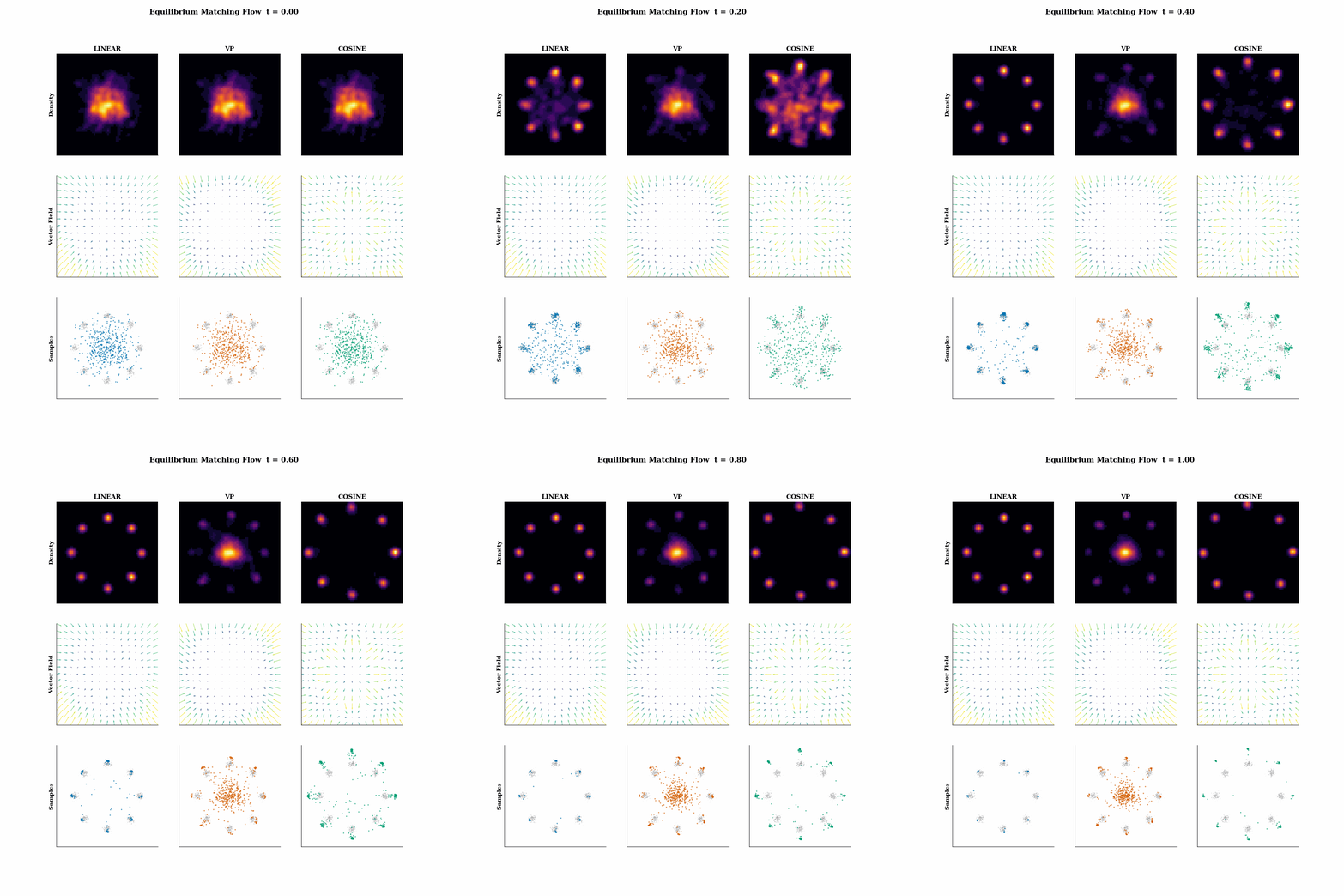
importtorchimporttorch.nnasnnfromtorch.utils.dataimportDataLoaderfromtorchebm.lossesimportEquilibriumMatchingLossfromtorchebm.samplersimportFlowSampler,NesterovSamplerfromtorchebm.coreimportBaseModelfromtorchebm.datasetsimportEightGaussiansDatasetdataset=EightGaussiansDataset(n_samples=8192)loader=DataLoader(dataset,batch_size=256,shuffle=True)# Any nn.Module with forward(x, t) worksclassVelocityNet(nn.Module):def__init__(self):super().__init__()self.net=nn.Sequential(nn.Linear(2,256),nn.SiLU(),nn.Linear(256,256),nn.SiLU(),nn.Linear(256,2))defforward(self,x,t,**kwargs):returnself.net(x)model=VelocityNet()loss_fn=EquilibriumMatchingLoss(model=model,interpolant="linear",energy_type="dot",)optimizer=torch.optim.Adam(model.parameters(),lr=3e-4)forepochinrange(50):forxinloader:loss=loss_fn(x)optimizer.zero_grad()loss.backward()optimizer.step()# Sample via ODE flowflow=FlowSampler(model=model,interpolant="linear",negate_velocity=True)flow_samples=flow.sample(x=torch.randn(1000,2),n_steps=100)# Same model as a scalar energy: g(x) = x · f(x)classLearnedEnergy(BaseModel):def__init__(self,net):super().__init__()self.net=netdefforward(self,x):t=torch.zeros(x.shape[0],device=x.device)return(x*self.net(x,t)).sum(-1)nesterov=NesterovSampler(LearnedEnergy(model),step_size=0.01,momentum=0.9)energy_samples=nesterov.sample(n_samples=1000,dim=2,n_steps=200)
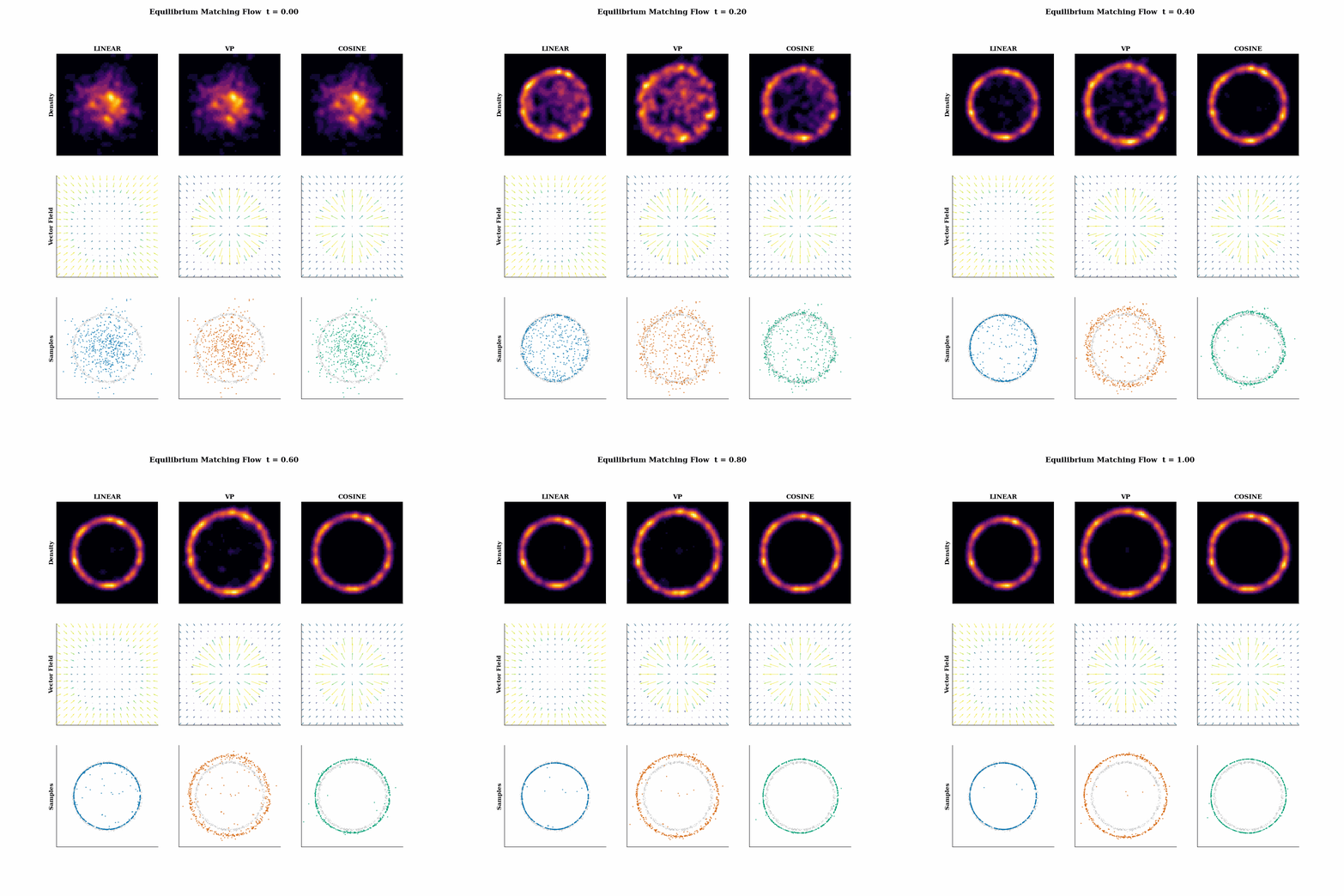
One model, two views: the flow view generates in a fixed number of steps, the energy view supports gradient-based refinement. That interchangeability is the library's central design property.
See the concepts and examples for the theory behind each component and a runnable, CI-tested curriculum.
Enjoying TorchEBM? A GitHub star helps others discover the project and motivates continued development.
@misc{ghaderi2024torchebm,author={Ghaderi, Soran},title={{TorchEBM}: A Composable {PyTorch} Library for Energy-Based and Transport-Based Generative Models},year={2024},howpublished={\url{https://github.com/soran-ghaderi/torchebm}},}