Publications
Mixed-Field Matching: Time-Conditioned Transport with Energy-Based Refinement
Abstract
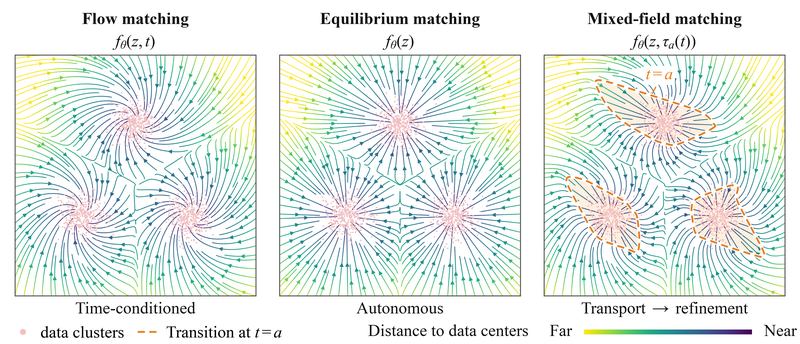
We introduce Mixed-Field Matching (MFM), which trains one network whose time input follows the noise level up to a threshold and stays fixed above it. Diffusion and flow-matching models give the network the noise level at every step of generation, while recent equilibrium models remove it entirely. We argue that the need for the noise level changes during generation. Far from the data, one noisy sample is consistent with many noise levels and many clean images, and the noise level reduces this uncertainty about where the sample should move. Close to the data, the manifold hypothesis suggests that the sample itself carries this information. MFM sampling first transports noise toward the data with the time-conditioned field and then refines each sample using a single time-independent field. A penalty that sets the field to zero on clean training examples keeps finished samples in place, so extra refinement steps do not degrade them. On a two-dimensional example where equilibrium matching (EqM) moves every sample onto the data but gives the modes the wrong proportions, MFM assigns samples to modes about as accurately as flow matching (FM). On ImageNet-256 with DiT-XL/2, at the same training and sampling cost as the baselines, MFM lowers FID by 15% relative to EqM and 28% relative to FM without guidance, and by 14% and 33% at a shared classifier-free guidance scale.
How to Train Your Energy-Based Transformer: Understanding Stability in EBMs
Abstract
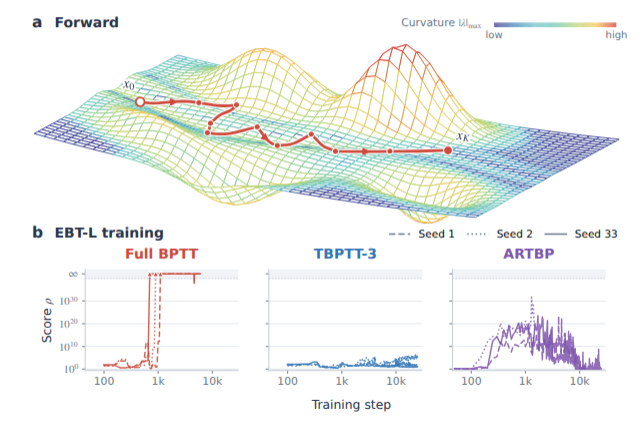
Diffusion and autoregressive models generate images, video, and text at scale. Energy-based models (EBMs) cast generation as energy minimization. They learn a scalar energy that scores how well a candidate output matches the data, and energy-based transformers (EBTs) scale this approach by implementing the energy with a transformer. An EBT generates by refining a prediction through a sequence of gradient descent updates on the energy, starting from a noisy or corrupted input. Training differentiates through this refinement sequence, the same computation as backpropagation through time (BPTT) in recurrent networks, and it is often unstable. We analyze this instability. Each backward step multiplies the gradient by a factor set by the step size and by the curvature of the energy with respect to the prediction. We bound the resulting growth and convert the bound into a curvature score computed during training. We compare full BPTT with two lower-cost gradient estimators, truncated BPTT, which differentiates only the last few updates, and Anticipated Reweighted Truncated Backpropagation (ARTBP), which cuts the sequence at random points and reweights the surviving terms to remove the bias introduced by the cut. In image denoising with three model sizes, we find that the best estimator changes with scale. ARTBP gives the highest final training reconstruction quality with the small model, while truncation to the last three updates is best for the base and large models. With the objective and forward trajectory fixed, we find that the truncated gradient changes from closely aligned with the full gradient early in training to pointing in the opposite direction later. The curvature score separates failed from successful completed runs and predicts training stability over a horizon that shrinks with model size.
Abstract
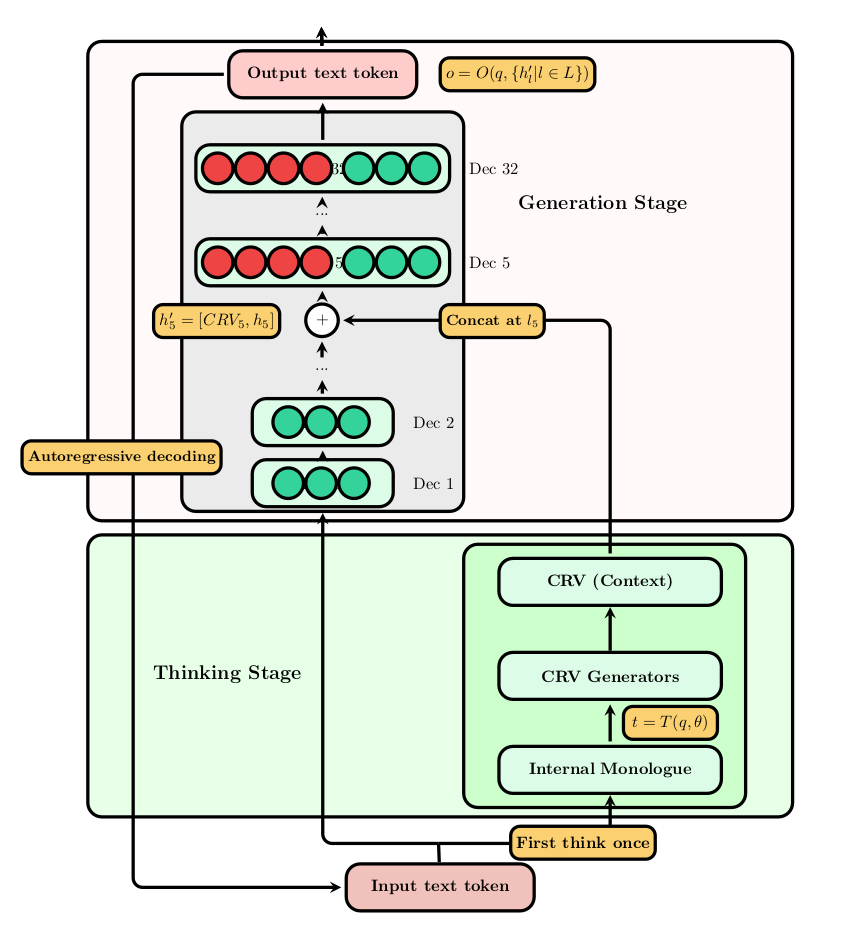
Despite advances in large language models (LLMs) for code generation, they still struggle in effectively utilizing contextual information throughout the generation process. To tackle this challenge, we introduce the Neural Integration of Iterative Reasoning (NIR) framework, which offers a new method for incorporating Context Representation Vectors (CRVs) at multiple levels within LLMs. NIR boosts the ability of these models to generate code without needing fine-tuning, allowing it to be used across various LLM architectures. We assess NIR by testing it with LLaMA 3.1 on the MBPP dataset, focusing on early, mid, and deep integration stages. Our experiments show that the depth of CRV integration has a notable impact on several facets of code generation, including response rates, syntactic correctness, and overall code structure. Deeper integration generally improves syntactic accuracy and code conciseness, while mid-layer integration shows optimal performance in semantic tasks. We report detailed evaluation metrics that assess code quality, complexity, and structure. Our findings indicate possible trade-offs among various code quality measures and emphasize the potential of adaptive integration strategies. While NIR demonstrates promising results, we also identify limitations such as dataset specificity and output inconsistencies. This study contributes to understanding contextual information processing in LLMs and might be useful for future developments in codeLLMs. We conclude by outlining future research directions, including multi-layer integration and dynamic adaptation strategies.